
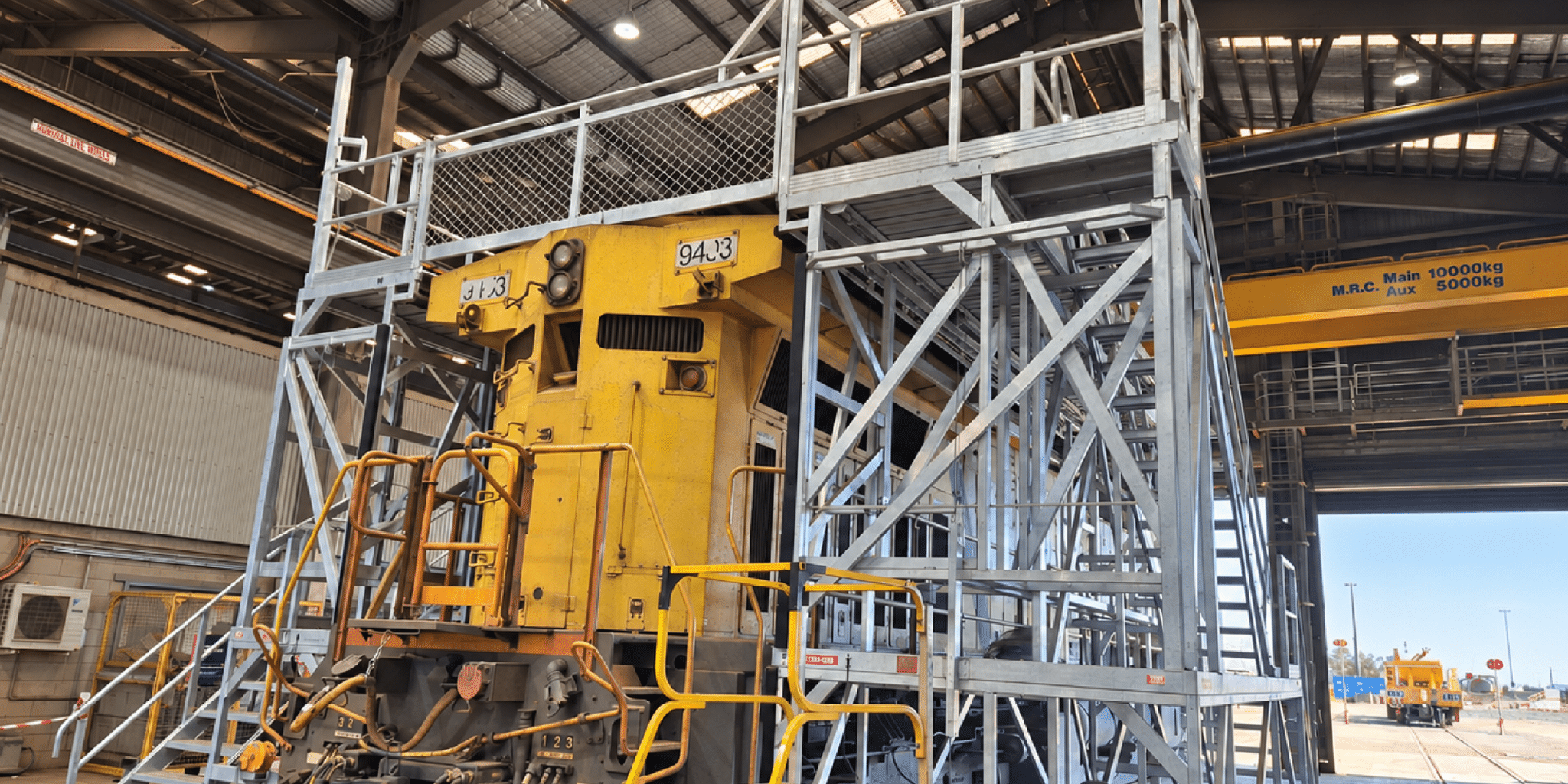
A train maintenance platform can make routine locomotive work faster by placing technicians, tools and services beside the components they need to reach. At Rio Tinto’s Wickham operation, the existing fixed steel gantry was built for the original Dash 9 series Locomotive and had gaps around the work area, not providing the flexibility needed across the newer Evo locomotives. Some tasks, including Radiator removal on an the Locomotives required additional temporary system scaffolding, with a wait of up to two days for the install to be scheduled by scaffolders. The replacement gantry was designed around two-sided access, dual level, sliding fingers, connected work areas and integrated service points for maintenance from the grids through to the radiators and turbo.
Heavy Haul Rail Maintenance Depends on Ready Access
Rio Tinto’s Pilbara rail system connects 18 mines through almost 2,000 kilometres of mainline. Near Wickham, the Cape Lambert terminals bring train unloading, stockyards and ship loaders together to keep iron ore moving from mine to port. Locomotive availability supports that wider flow, so maintenance access needs to be ready when planned inspections, component work and replacements enter the workshop.
The work on top of a locomotive is spread across distinct zones. Grids sit towards the front and dissipate heat. Radiators are positioned towards the rear, where covers need to be inspected, removed and replaced. Turbo and water flow valves sit nearby, and major work can require roof panels or radiator components to be lifted clear. One access arrangement therefore needs to support movement between tasks without creating risk around the changing locomotive profile, driving efficiency.
Why the Existing Fixed Gantry Needed Replacing
The existing overhead gantry left gaps around the locomotive and did not give the maintenance team simple access to every service point. For Evo radiator removal, scaffolders were required to create temporary access, adding a wait of up to two days before the maintenance sequence could continue. Repeating that process consumed time and introduced another mobilisation into a planned workshop task.
A like-for-like structure would have carried the same limitations into the replacement. The new design needed platforms on both sides, geometry that worked with Evo and Dash 9 locomotives, and clear access to the grids, radiators, turbo and water flow valves. It also needed to preserve door operation and refuelling access while bringing power, air and ventilation support closer to the workface.
A Two-Sided Locomotive Roof Access Gantry
The replacement gantry was designed around two-sided access to replace the fixed steel structure. The paired platforms create working areas on both sides of the locomotive, allowing technicians to approach roof components from the side that best suits the task. The layout follows the maintenance sequence rather than treating the locomotive roof as one uniform surface.
AS 1657:2018 was nominated for the access system. Platform levels, stairs, handrails, midrails, gates and kickboard protection were considered together so technicians could enter the work area and move between service zones from a defined platform. SafeSmart’s Fixed Gantry Walkway range also supports project-specific dimensions, decking, three-dimensional modelling and integration with workshop tooling. 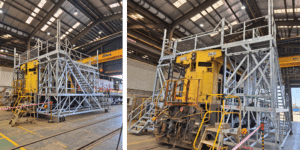
How the Train Maintenance Platform Supports Each Task
Sliding Fingers Close Gaps and Retract for Component Removal
The design uses sliding fingers that extend 700 millimetres from the platform edge to close the space beside different locomotive profiles. Technicians can extend them for routine access, then slide them back providing access to different areas on the Locomotive, while executing the work flow of a single task to like reaching radiator bolt connections or create clearance for removing the roof above the turbo. This turns gap control into an operating feature of the platform rather than a separate setup step.
A Bridging Platform Connects the Rear Work Zones
The design includes a bridging platform approximately one metre wide between the turbo and radiator work areas. That connection gives technicians a continuous route through adjacent maintenance zones and space to position themselves for inspections, cover removal and component work. It also reduces the need to descend and approach the locomotive from another access point during the same job.
Telescoping Mesh Gates Protect the Connection
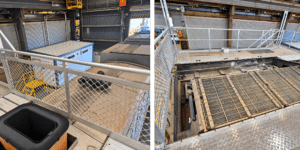
The design uses swing gates to connect the two platform units with handrail and midrail protection. A sliding mesh frame telescopes down to kickboard height, maintaining edge protection across the changing opening. The gate arrangement allows the connection to be opened for the task and closed as part of the normal platform setup.
Clearances Preserve Refuelling and Door Access
The design sets the lower structure back 100 millimetres from the leading edge of the lower platform to clear the locomotive refuelling point. On the upper level, the supporting structure remains as shallow as possible so the three doors on the right-hand side can open. These details keep the train maintenance platform clear of functions that continue around the maintenance task.
Built-In Services Keep Tools Near the Workface
The design positions four fan mounts at the platform corners, with 240-volt power specified at those locations. A hose reel in one corner provides a 30-metre hose for the remaining air requirement, while battery tools cover much of the day-to-day work. Locating these services on the platform reduces repeated travel to collect leads, hoses and ventilation equipment.
Fork Tine Slots Support Future Relocation
Fork tine slots are specified in both the upper and lower platforms so the modules can be handled for future transport. Designing the handling points into the structure avoids retrofitting a lifting method later and gives the workshop a clear pathway for relocating the platform if the maintenance layout changes.
A Layout Designed for Efficient
Locomotive Maintenance
The replacement design brings repeated locomotive tasks into one planned access system. Technicians can reach the grids, radiator area, turbo and water flow valves from connected work surfaces, while the sliding fingers and bridge adapt the platform edge to the work underway. The connected layout reduces the stop-start pattern created when temporary access has to be organised between stages of a job.
Two-sided access adds flexibility across the Evo and Dash 9 fleet. Integrated power, air and fan mounting points keep common services close to technicians. The clearances for doors and refuelling allow surrounding locomotive functions to remain usable, and the fork tine slots preserve future transport options. Together, these features reduce recurring setup effort and the access delays associated with temporary scaffolding.
Planning Rail Maintenance Platforms Around the Fleet
Effective rail maintenance platforms start with the fleet and the maintenance sequence. Map every locomotive profile that will enter the road, then record component locations, removable panels, door swing, refuelling points and lifting paths. Add the tools, ventilation, power and air needed at each zone. This information shows where the platform edge must extend, retract, bridge or stay clear.
The access format can then match the workshop. A fixed gantry suits repeated work along a dedicated maintenance road. A locomotive HVAC platform can provide dual-level access for roof-mounted equipment, while a rolling stock access platform can be configured for side, end or component-specific work. The Rio Tinto design combines these principles in one task-led platform for different locomotive types and maintenance sequences.
Get Your Workshop Fitted Out
A fixed gantry is well suited to repeated maintenance along the same section of track. A complete rail workshop, however, also needs access to driver cabs, carriage doors, vehicle sides, roof equipment, windscreens, front-end components and couplers.
SafeSmart can design a coordinated train maintenance platform range around the fleet, workshop layout and tasks completed in each bay. Fixed platforms can serve regular maintenance positions, while mobile and height-adjustable platforms can move between different vehicles and work areas.
- Train Maintenance Platform for Driver Access: Provides a level working area beside the locomotive cab and driver access points. The mobile platform combines 45-degree stair access with a perforated deck, self-closing gate and reversible guardrails. Large castors allow maintenance teams to reposition it between vehicles and workshop bays.
- Height Adjustable Train Platform Access Kit: Combines two height-adjustable cantilevered platforms with a joining bridge. The platforms can be used separately or connected at the sides or ends, allowing technicians to configure access around different rolling stock profiles. Its adjustable working height supports roof and upper-side maintenance across a mixed fleet.
- Adjustable Rail Roof Access Platform: Gives technicians mobile, height-adjustable access to roof-mounted HVAC units, electrical equipment and other rooftop components. The cantilevered deck positions workers close to the task, while telescopic guardrails extend across the roof to create an edge-protected work area.
- Tram Maintenance and Refurbishment Platform: Supports major side and roof work during tram refurbishment programs. The system combines a long side platform, mobile edge protection on the opposite side and telescopic cross-roof guardrails. This gives teams access for interior strip-outs, air-conditioning work, pantograph servicing and other roof-level tasks.
- Dual Level Train Maintenance Platform: Provides carriage-level and roof-level access from one platform. Technicians can enter the carriage and reach rooftop work areas without stopping to adjust the platform between tasks. The large work area also provides space for multiple workers’ tools and maintenance equipment.
- Front of LRV Adjustable Height Access Platform: Follows the windscreen profile of a light rail vehicle so technicians can work close to the front without an open gap between the deck and vehicle. Its height adjusts from 2.0 to 2.85 metres for windscreen work, destination-display maintenance, cleaning and access to other upper-front components.
- Front of Train Access Platforms: Bring technicians into position for work on windscreens, headlights, wipers, destination displays and front-side components. Cantilevered, slider, ladder and stair-access configurations can be designed around passenger trains or freight locomotives. Profiled platform edges and protective buffering allow close access while protecting the rolling stock.
- Mobile Coupler Access Platform: Rolls into position wherever coupler work is required. Its cantilevered deck reduces the gap to the train, while the large work area, reversible guardrails and 45-degree stair give technicians room to inspect, service and replace coupler components. It can then be moved to the next vehicle or maintenance bay.
- Fixed Coupler Access Platform: Creates a dedicated coupler maintenance station using two outer access platforms and a centre bridge. It provides space for inspections, repairs and assembly work around the coupling system. The platform can be mounted to concrete or steel workshop structures and fitted with removable handrails.
- Fixed Gantry Walkway: Provides permanent, full-length access beside the track for recurring work along the upper sides and roofline. SafeSmart can size the gantry to the maintenance bay, select the required deck surface and integrate workshop tooling. The structure can also be engineered around surrounding services, equipment and building clearances.
Planned as one workshop access system, these platforms give technicians a practical route to every part of the rolling stock. Teams can move from the driver’s cab and vehicle front to the carriage sides, roof equipment and couplers without setting up ladders or temporary scaffolding for each task.
SafeSmart scopes the fleet, maintenance sequence, workshop structure and available floor space before engineering the fixed and mobile platform mix. The result is a workshop fitted around the work being completed, with purpose-designed access ready at each maintenance position.
Configure a Train Maintenance Platform Around Your Fleet
Request a rail maintenance access review and share your locomotive types, maintenance tasks, component-removal paths and workshop services with SafeSmart. We can develop locomotive maintenance access around the way your technicians inspect, service and replace equipment, with platform geometry and integrated tooling planned for the full maintenance sequence.

