
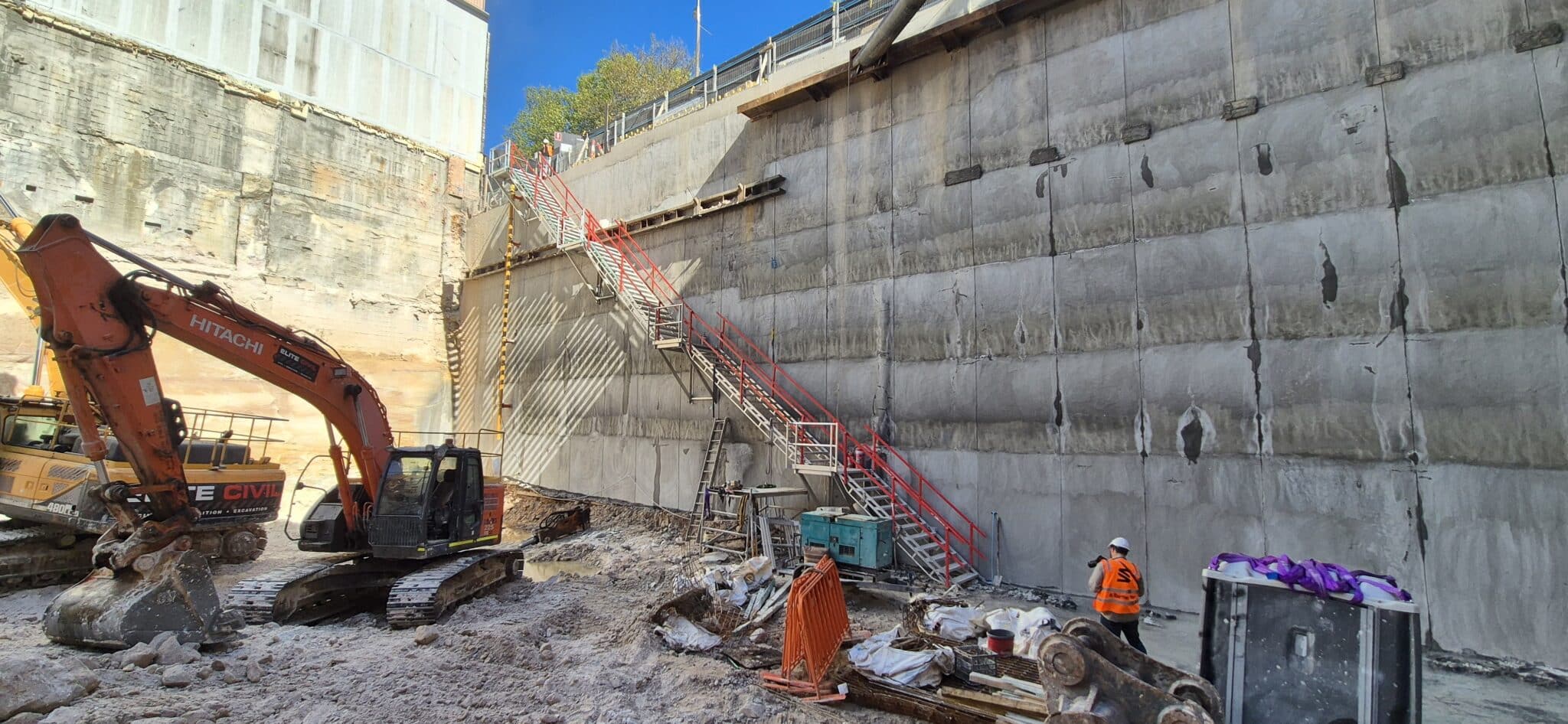
Temporary access stairs can keep a basement excavation moving when the access route must descend with the dig. At Amara Mosman, Fleek Constructions needed a lightweight route into the basement that would avoid the higher loads created by the scaffold stair option assessed for the site. The access also had to leave the excavation below open for work and adapt as the basement depth grew. SafeSmart combined aluminium AdjustaStairs with Hanging Landings in a suspended arrangement. The crew could install, crane and reconfigure the system as work progressed, then reuse the equipment during formwork, structure and hoarding stages.
Basement Access Needed to Stay Ahead of the Dig
Amara is a residential development at 700 Military Road in Mosman. Fleek Constructions delivers high-end residential and commercial projects across Sydney, and the basement excavation at Amara required a defined route from ground level to the active work area below.
Every reduction in excavation level changed the vertical distance and approach to the workface. A ground-supported access system would have occupied part of the excavation area that Fleek needed to keep working beneath. Fleek needed a lightweight, suspended system that could be installed and added to as the excavation deepened.
Why a Conventional Scaffold Stair Added Too Much Load
The steel scaffold stair arrangement assessed for the project placed more load on the excavation wall than the site could support. It would also have introduced a ground-supported footprint into the area that Fleek still needed to excavate. As the dig advanced, the team would have had to dismantle or and relocate that access repeatedly before work could continue beneath it. With the installation cost increasing with every alteration or movement.
The required solution was a complete suspended route rather than a single stair flight. It needed an upper connection, landings between flights, handrails and a lower transition that could move with the changing level. Bringing those elements into one component-based system allowed the access route and excavation sequence to be planned together.
How the Suspended AdjustaStairs System Worked
Lightweight Aluminium Flights Reduced the Structural Demand
AdjustaStairs are made from marine-grade aluminium and are available in 600mm and 1200mm widths. Their articulating design allows the angle to be reset as the excavation level changes while the treads remain level. At Amara, the aluminium flights provided temporary construction access without the weight of the scaffold alternative assessed for the excavation wall.
Hanging Landings Connected the Route Above the Dig
SafeSmart’s Hanging Landing provides a connection point between AdjustaStairs flights as a basement or shaft becomes deeper. The standard landing is 1.52 metres wide by 0.96 metres long and uses wall braces to support the suspended platform. At Amara, the hanging configuration kept the stair route off the excavation floor, so Fleek could continue digging and working beneath the accessway.
Craneable Components Made Each Change Faster
The project system could be lifted by crane or excavator and added to as the access depth changed. Fleek’s crew could move the flights and landings as a coordinated arrangement instead of dismantling a full scaffold stair tower. This shortened the changeover and kept the basement route aligned with the next excavation stage.
Installing and Extending Access as Excavation Advanced
The component-based arrangement also simplified installation and relocation. Fleek’s site team could progressively install AdjustaStairs flights and Hanging Landings as excavation advanced, extending the access route to suit the changing site levels.
As construction progressed from the basement back towards ground level, the system could also be progressively dismantled, removing flights and landings as they were no longer required.
The site team could install, adjust and remove the system without a ticketed scaffold crew or the recurring monthly sign-offs associated with the scaffold option. After each adjustment, the team could repeat the necessary support, connection, handrail and landing checks before returning the route to service.
Reusing the Same Access Through Later Project Stages
The value of portable stairs continued after bulk excavation. Fleek could re use the AdjustaStairsfor access during formwork and structure phase, as well as other applications eg. temporary hoarding access. The equipment followed the access demand instead of becoming redundant when one basement stage finished.
Planning that reuse early helps a project choose flight lengths, widths and landing components that suit more than one phase and more than just one project. It also gives the site team a lifting and storage plan before the system needs to move. At Amara, the supplied components supported changing basement access and remained available for later applications on the job.
Planning Temporary Access Stairs for a Basement Excavation
Start with the full depth range rather than the current excavation level. Record the available run at each stage, the intended stair width and the points where workers enter and leave the route. Then confirm the capacity and geometry of the upper structure or wall that will support the landings and flights.
Map the excavation plant envelope beneath the proposed accessway, including the area needed for digging, spoil removal and crane movements. Define when another flight or landing will be added, where the system will be placed during each lift and how it can serve the formwork, structure or hoarding stages later. These inputs allow SafeSmart to configure adjustable stairs and suspended landings around the actual construction sequence.
Plan Suspended Basement Access Before the Dig Advances
Request an access review by sending SafeSmart the excavation plan, depth range, wall or support details, plant movement zone and proposed lift sequence. Our team can configure AdjustaStairs and Hanging Landings into a temporary access system that follows the dig and later construction stages.

