

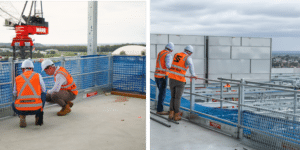
Concrete-fixed edge protection on a changing data centre workface must protect the perimeter while allowing planned access for facade installation and work around service penetrations. At a Huntingwood data centre, AW Edwards needed a system that could be reused from level to level and moved between buildings. SafeSmart supplied AdaptaPanel WorkThru with removable mesh panels and removable kickboards. The arrangement let crews reach the workface without removing the full barrier. The project brief records that the system was efficient to install and relocate, giving the site a repeatable method for its changing construction sequence.
Project context and required task
The SafeSmart brief identifies AW Edwards as the client and Huntingwood as the data centre location. Bouygues Construction also describes AW Edwards as its Australian subsidiary delivering the AirTrunk SYD3 hyperscale campus expansion in Western Sydney. That project information places the access task within a large data centre construction programme in the region.
The access task focused on facade installation and service penetrations near live edges. Protection needed to remain useful as the workface changed. It also had to support reuse across levels and buildings rather than being treated as a single fixed installation.
Why a fixed barrier did not fit the workface
A conventional barrier can protect an edge yet obstruct the activity that must occur beside it. Facade teams need access to the perimeter. Services work may also require local access around a penetration. Removing an entire edge protection run for each task would work against the protection method recorded in the brief.
The site instead needed temporary edge protection that could change locally while the remaining barrier stayed in place. Reuse also mattered because the workfront moved through more than one level and building.
The SafeSmart solution
SafeSmart supplied the AdaptaPanel WorkThru system. This form of work-through edge protection uses removable mesh sections and kickboards so planned work can proceed through part of the barrier. The rest of the panel line can remain in position, subject to the approved site method.
The system was selected for its ability to be installed, removed and relocated as the project sequence changed. That made the concrete edge protection useful beyond one workface and supported the reuse requirement set by AW Edwards.
How the WorkThru configuration supported the site
Removable mesh panels
Crews could remove the relevant mesh panel where the approved work method required access. This opened a defined part of the workface instead of taking down the complete barrier run.
Removable kickboards
Removable kickboards allowed the lower part of the opening to change with the task. Their use and reinstatement still formed part of the site procedure for the selected configuration.
Relocation between work areas
The project brief records efficient installation and relocation. As facade and penetration work moved, the panel system could be reassigned to another level or building in line with the construction programme.
Protection beside the opening
Opening one work area did not require the surrounding panels to be removed. This kept the barrier arrangement focused on the active task while retaining protection beside the live edge.
Standards and project conditions
The project brief records AS 4991 and AS 1657 for edge protection. Those references are project facts, not a blanket compliance statement for every AdaptaPanel WorkThru arrangement. Project teams should have a competent technical reviewer confirm the applicable standard titles, editions, fixing details and approved configuration for their installation.
Outcomes for the project team
AW Edwards received a concrete edge protection method that could move with the work sequence. Removable mesh panels and kickboards allowed planned access for facade and service penetration work. The project brief also confirms that the system was efficient to install and relocate.
These outcomes belong to the recorded project configuration. Other data centre edge protection applications may have different slab interfaces, fixing locations, opening sizes or work methods, so the final arrangement still needs site review.
What other project teams can apply
When perimeter work must continue beside the edge, plan how each barrier section will open and be reinstated before installation. Provide the slab and facade details, penetration locations, work sequence and proposed relocation plan. That information helps the protection method follow the task instead of becoming an obstacle to it.
Review the changing workface before installation
Send SafeSmart the edge layout, fixing interface, facade sequence and penetration plan. The team can review whether AdaptaPanel WorkThru suits the application and identify the technical checks needed for the proposed configuration.

