

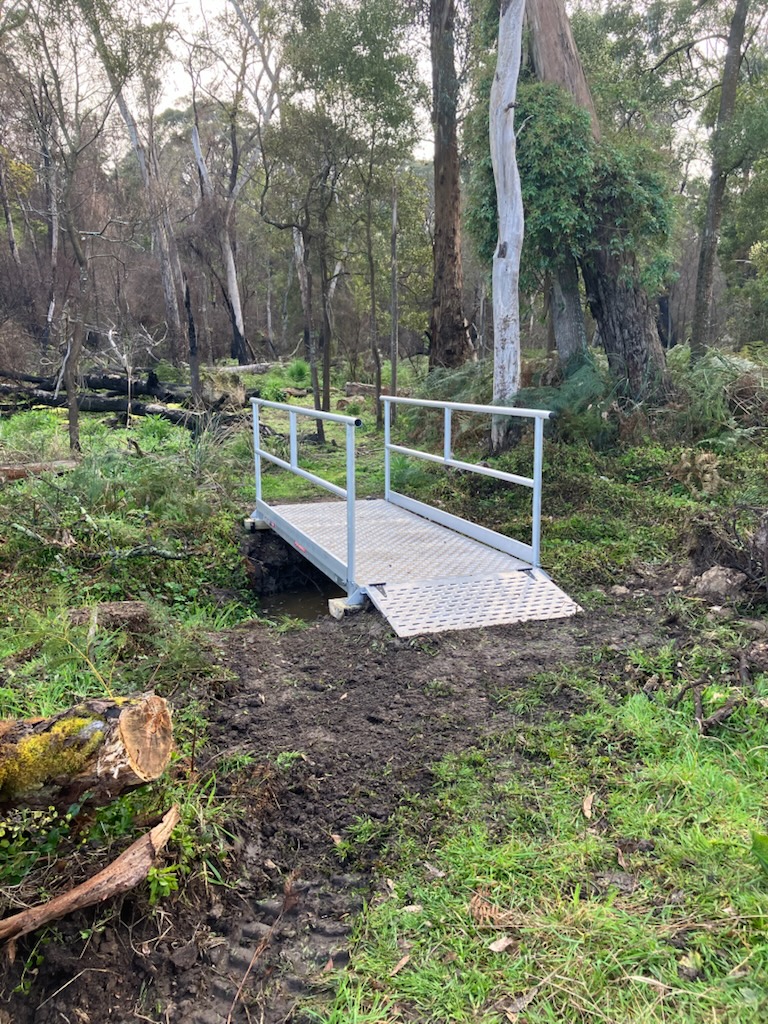




The SafeSmart Access Portable Bridge is a pedestrian bridge designed for foot traffic and other non-motorised users who need temporary, reliable passage over trenches, ditches, pits, small waterways, and similar site barriers. By separating pedestrians from nearby vehicle traffic at these crossing points, it improves safety on work and event sites where normal walking routes are interrupted. Spanning 1.2m in width and available in lengths of 3.0m and 4.2m, it provides sturdy, safe access for workers, site teams, and their tools.
For project managers, construction teams, and event organisers who need temporary walking and cycling access at a specific site location, the Portable Bridge by SafeSmart Access offers a practical way to maintain movement across barriers while supporting safer transport routes for pedestrians and cyclists. This kind of infrastructure can improve walkability, maintain access between separated areas, and keep temporary routes usable where high foot traffic or changing ground conditions would otherwise slow movement. Manufactured in New Zealand with high-quality, resilient materials, this bridge adheres to the stringent standards of AS/NZS 1657 : 2018. Temporary pedestrian bridges can also connect neighbourhoods, work zones, or public transport access points when normal routes are cut off. Depending on the site location, installation and construction planning may also require short road closures or traffic diversions.
Designed for practicality, the bridge has a 225kg safe working load, removable handrails, and a flat-pack format that simplifies transportation between locations. The hinged end flaps reduce trip hazards, while the choice of a high-grip black surface deck or a perforated aluminium deck allows the bridge to suit different environmental conditions with reliable grip and drainage in wet or muddy scenarios.
The footbridge’s design, specifications, safety features, and load capacity make for a low-maintenance structure. For any industries and site conditions where temporary access is required
Ensuring the safety of personnel is paramount, and the Portable Pedestrian Bridge significantly contributes to a reduced risk of on-site accidents; in bridge design, poor design can deter pedestrian use and push people toward dangerous street crossings. Meeting the rigorous compliance standards, its stable construction and safety features, like the extra-height guardrails and the hinged flaps, support a safer design, while the deck surface should provide sufficient traction and slip resistance in wet conditions. High-grip and perforated deck options add textured surfaces that help meet ADA slip-resistance expectations for pedestrian use. Transitions should stay under ½ inch to reduce tripping risk. Routine maintenance is still needed to preserve safe, functional performance over the bridge’s life.
Tailored for a range of applications, the bridge simplifies site access in situations such as planning where site conditions, water crossings, elevation changes, and the bridge’s exact location all need to be assessed.
Bridge design should also align the clear width with the approaching trail, since width affects loading requirements and user flow.
Each application benefits from the bridge’s attributes, which solve the challenges of accessibility, transportability, and compliance with safety regulations. This also helps people safely cross existing infrastructure, whether the route serves public open space, residential communities, or a site that connects key areas.
If you’re looking for an effective, safe, and versatile portable bridge solution, consider SafeSmart’s Portable Pedestrian Bridge. For any larger canal or river crossings, consider AdaptaSpan.