
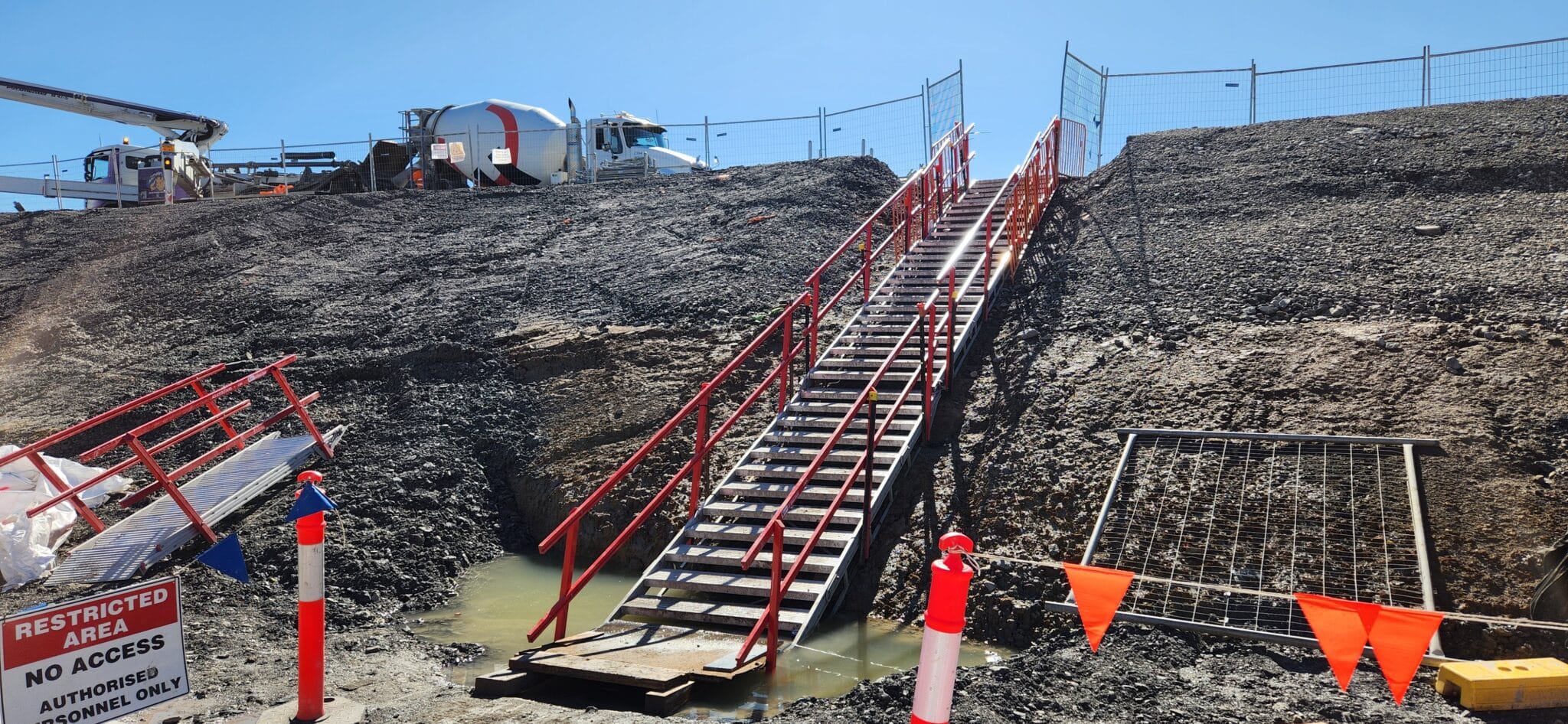
Batter stairs are temporary, adjustable aluminium stair systems designed to provide safe, efficient access to trenches and excavations on sloped earth banks. In construction, “batter” refers to the deliberate slope of the excavation face or surface.
The SafeSmart Access Adjustable Aluminium Safety Stairs provide an ideal access option for construction workers, site managers, and safety personnel who need a practical alternative to scaffolding stairs and straight ladder access during excavation work. Constructed from lightweight aluminium, they are simple and quick to install, and this page covers their key features and benefits, how they compare with other temporary access options, and a case study showing how they perform on site.
This is especially important in areas where the excavation is constantly progressing, as it allows for easy, time-efficient relocation of the stairs. The marine-grade aluminium is a high-tensile T6 class, so the stairs will not deteriorate over time, and the inherent strength of the material means that they are not easily damaged.
Advantages of Self-Levelling Stairs over Scaffolding Stairs:
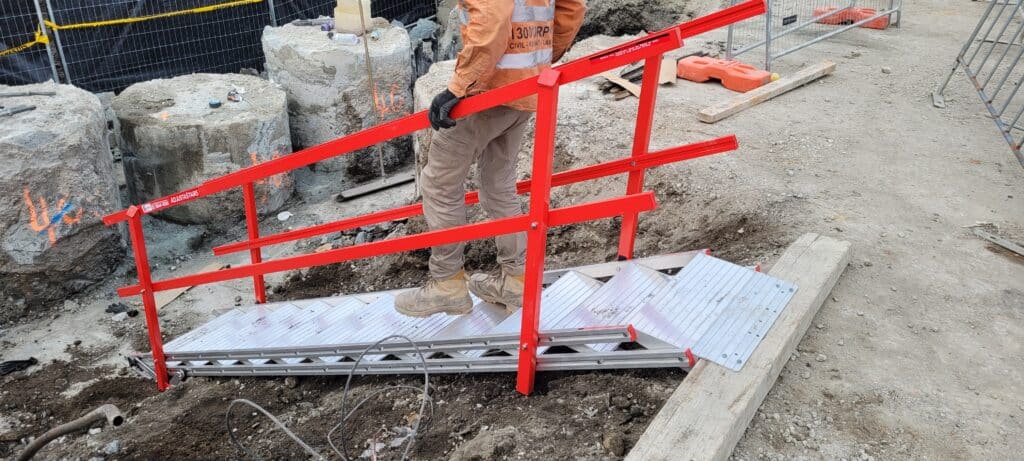
- Can be set up in around 10 minutes by any competent person/s: no scaffolder’s ticket required
- Easily relocatable: simply unbolt and move to next access point
- Small footprint: no scaffold set-up required
- Unlike scaffold, stairs will self-level to provide access at exactly the level of the excavation
- Used for temporary access where permanent stairs do not exist, making the steps practical for changing work areas
- Wide, slip-resistant treads and secure handrails help prevent slips and falls
- Aluminium: does not deteriorate over time like steel scaffold systems and can be configured to span varying heights on job sites
Advantages for Excavation Access over Straight Ladder Access:
- Much safer: Full stair angle of access rather than a ladder angle, with the walking surface staying securely horizontal as slope angles change on construction sites
- Users can walk up and down stairs forwards carrying tools and equipment, and the layout supports safer two-way movement on busy access routes than ladder access while handling more weight
- The stair system improves stability by distributing weight evenly across a sloped footing
- Ladders can be dangerous and difficult to tie off properly in an excavation
Advantages of Portable Stairs over Concrete or Timber Sleepers
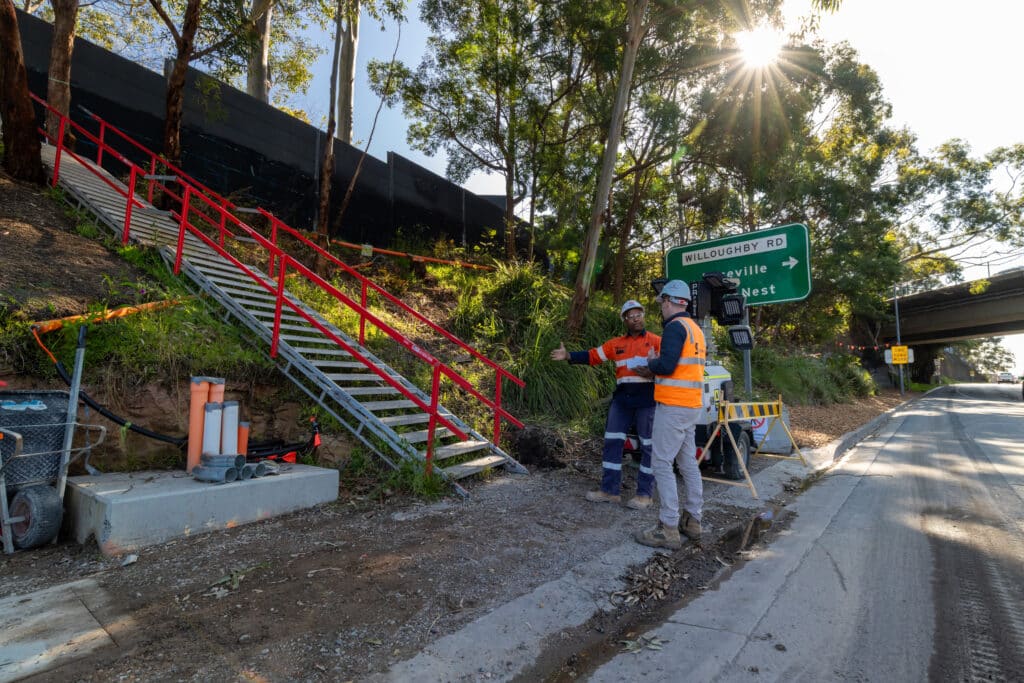
- The treads stay level as the stair angle changes, giving workers defined steps across the batter.
- The stairs can move with the excavation. A route made from fixed sleepers or cut into the batter may need to be rebuilt when the access point changes.
- The batter need not become the walking surface. At NorthConnex, cutting steps into shotcrete was ruled out because the surface would have needed respraying.
- Handrails run alongside the route, providing support when workers climb or descend.
- A timber sleeper can still form part of the fixing arrangement. The difference is that workers use the stair treads rather than the sleeper as steps. The fixing method must suit the site conditions.
Advantages of a Temporary Stair System over Standalone Self-Levelling Stairs
A self-levelling stair flight gets workers across one change in height. A temporary stair system can connect multiple flights, landings and existing scaffold access as the excavation progresses. That gives the site a planned route from the top of the batter to the work area below.
Risers and transitions
A riser is the vertical distance between steps. Although AdjustaStairs’ treads remain level as the stair angle changes, the riser heights and the transitions onto and off the stairs must be checked each time the system is positioned or moved. A level tread does not make an uneven first or last step disappear.
Mid landings and compatibility
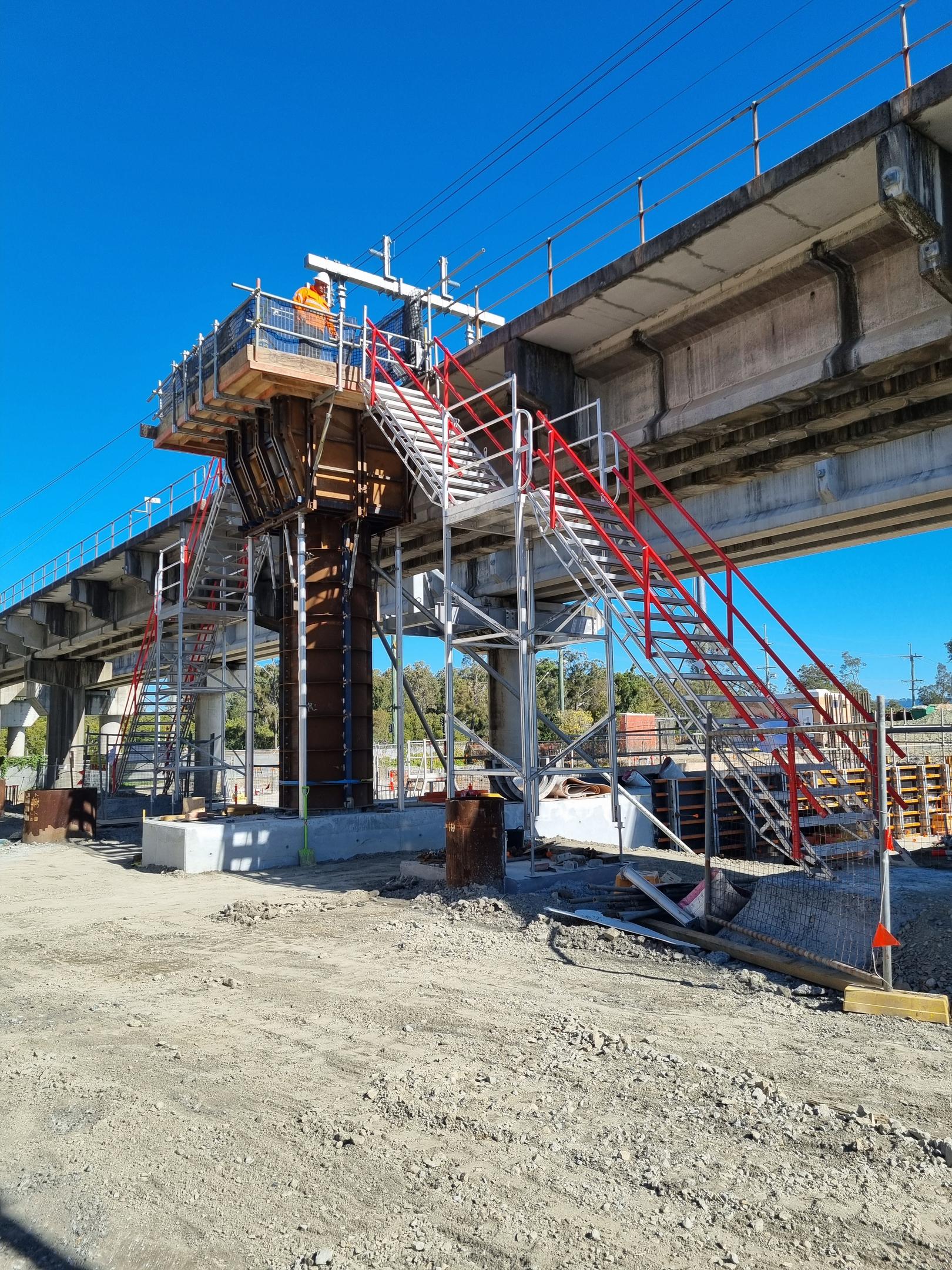
Mid landings connect flights where a batter is too long for one set of stairs, or where the route needs to turn. SafeSmart’s modular mid landings can be configured for landing heights from 1 m to 4 m. Hanging landings provide another option for routes into pits, shafts and basements.
The accessories work together to build the required route. Step extensions, handrails, guardrails and landings can be selected for the stair width and layout. AdjustaStairs can also connect with compatible scaffold systems: a scaffold mount hook connects the appropriate stair model to a scaffold ledger, while top and mid landings can be built using Proscaf. The connections and accessories are specified for the particular configuration, so crews have a continuous route rather than separate pieces of access equipment.
Standards and site requirements
SafeSmart’s AdjustaStairs brochure identifies AS/NZS 1576.1:2019 and AS 1657:2018 in its product guidance. It states that the stairs meet the relevant tread and handrail loading requirements and can be configured to meet the respective stair geometry requirements. The complete arrangement, including risers, landings, guardrails, fixings and any scaffold connections, should be selected and documented for the site. If stretcher access is required, tell SafeSmart during scoping so the stair width and full route can be planned for it.
Case Studies: Temporary Works for Civil Construction Sites
Warringah Freeway Upgrade Batter Stairs
Mainland Civil, Sydney
Mainland Civil contacted SafeSmart, interested in replacing the ladder access into their excavation on site with an adjustable stair. The workers on site did not feel safe or confident climbing down into the excavation with a series of ladders. This was mainly because they had to climb around the upper portion of the ladder to climb down into the pit, and there was a risk of slipping around the lip of the excavation. The ladder was also unstable against the lip of the excavation, and the angle made it very difficult to bring any tools down into the pit. As a temporary access solution for construction sites, self-levelling stairs can be adjusted to match changing excavation depths without custom-built solutions. They can also be attached end-to-end for longer staircases where site access requires a greater run.
SafeSmart set the stairs up on site as a trial. As temporary stairs with adjustable height elevation, they can be set to the correct height to suit a range of excavation depths and access levels. Engineering certification is available, and anti-slip treads are included as part of the unique design for safety, while the compliance plate comes fitted so compliance and support are covered.
The feedback we had was that the workers were now able to access their work areas in the excavation in a much safer manner, and the ease of access and carrying tools up and down the stair meant that this system was much more time efficient than using the ladders. They were also easily able to relocate the stair themselves as required, making efficient use of space by aligning to irregular site topography.
Batter access at NorthConnex
At NorthConnex, crews needed to move up and down a shotcrete batter during tunnel entrance works. Ladders were unsuitable, and cutting steps into the batter would have meant respraying the surface. SafeSmart supplied adjustable portable stairs so workers and subcontractors could enter and leave the excavation. The project team reported faster access as work continued at different points on site. Read the NorthConnex case study.
Batter access at Kingsford Smith Drive
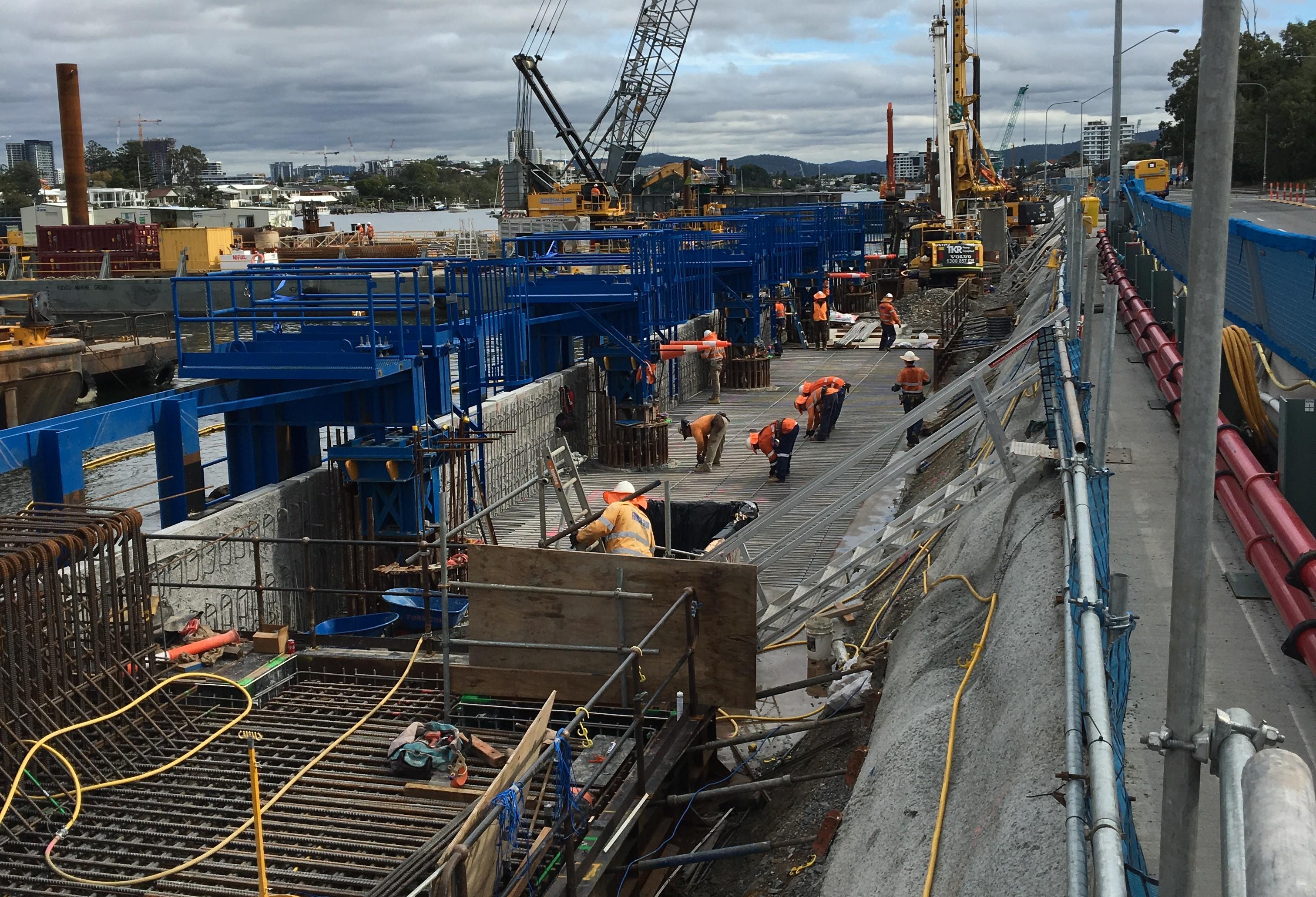
During the Kingsford Smith Drive upgrade, Lendlease needed daily access across shotcrete-lined excavations. The batter became harder to negotiate after rain. AdjustaStairs were secured at the top and bottom to give crews a defined route up and down. As the work moved, the stairs could be collapsed and redeployed at another access point. Read the Kingsford Smith Drive case study.
Temporary stairs that moved with the project
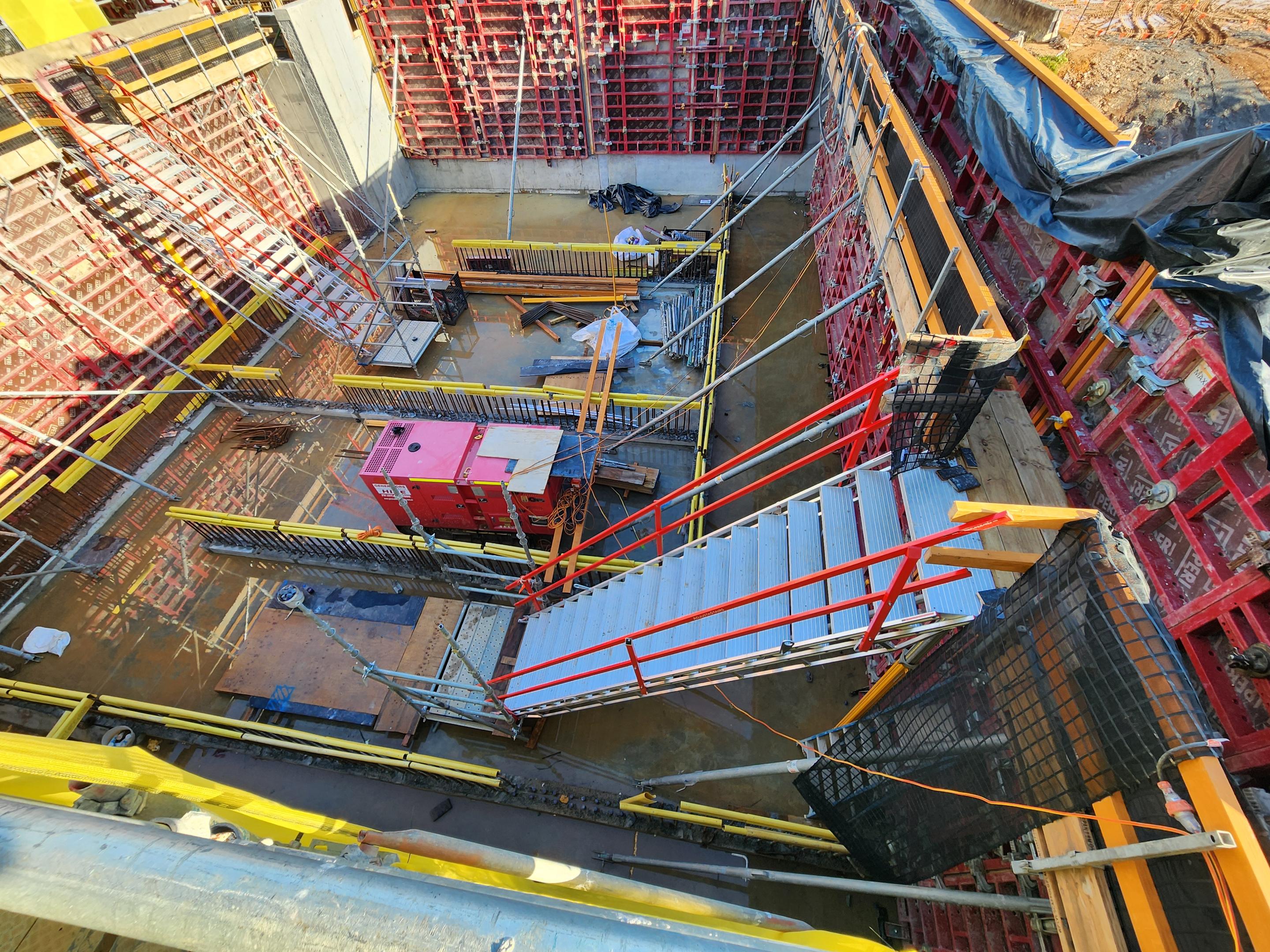
Batter access is one use for the same adjustable stair system. At the Southern Redland Bay wastewater treatment plant, Silverstrand used AdjustaStairs to reach formwork and enter concrete tank cavities. The stairs were moved and reconfigured as construction progressed. This was a formwork access project, but it shows how the system can serve changing access points across a site. Read the Silverstrand case study.
Planning stair access on a batter
Start with the batter angle, the height to be reached and where the stairs can be secured at the top and bottom. Consider how many people will use the route, whether they will carry tools, and whether the access point will move during the project. SafeSmart can help work through the stair configuration and fixing requirements for the site.
The AdjustaStairs Batter Stairs Calculator can help you explore stair sizes using the slope, length and preferred width. For a wider look at stairs used in civil works, see A Guide to Scaffolds and Stairs. Talk to SafeSmart about the site conditions before selecting a final configuration.
Want to know more about our adjustable stairs? See AdjustaStairs portable stairs here.

