
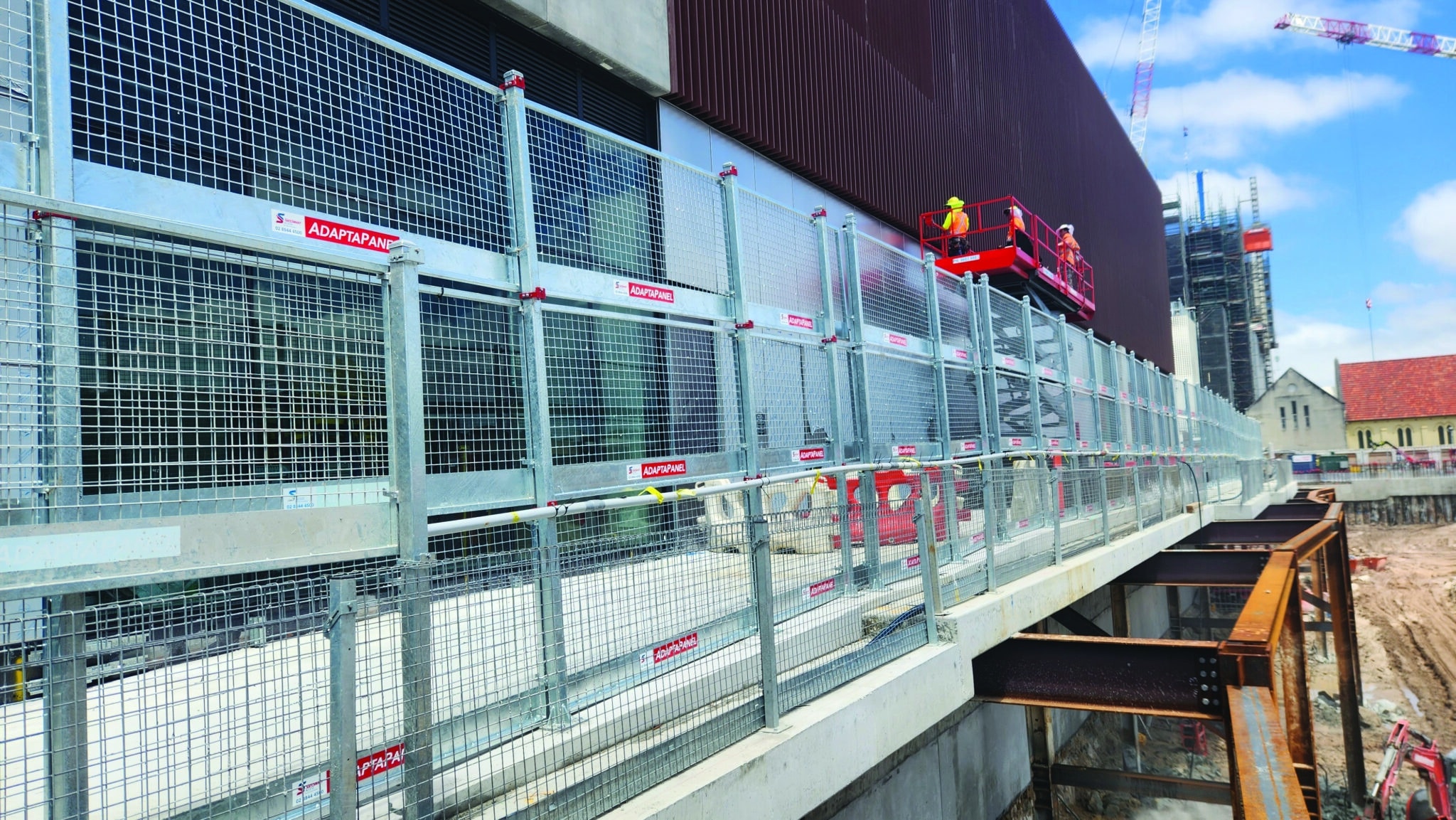
When people work near an edge, the first job is to remove the risk. Australia has two key rulebooks that set the bar for doing that right. Here’s what they say, in clear language, and how Adaptapanel helps you meet them.
The two rulebooks
Temporary edge protection, Standard 4994.1.
This joint Australian–New Zealand standard covers temporary barriers used during construction and maintenance. The current edition was published on 10 November 2023. It sets the requirements for design, manufacture, installation and testing.
Permanent access, Standard 1657.
This standard covers fixed platforms, walkways, stairs, ladders and their guardrails for long-term use. The current edition was published in 2018.
Which one applies? Use the temporary rulebook when the barrier is there for the job. Use the permanent rulebook when the access will remain for ongoing work.
Scope details most people miss (but OH&S don’t)
- Roof pitch limit: The temporary rulebook is written for roofs up to and including 35 degrees. Steeper roofs need specific design.
- People first, debris separate: The temporary rulebook is about protecting people at edges. It does not cover catching materials; if you need debris control, use toe-boards or mesh or set exclusion zones.
What regulators expect before you choose gear
Guidance from New South Wales is blunt: where you can’t eliminate the need to work at height, physical guardrails are the best control for roof edges. Harness systems should only be considered after a risk assessment shows edge protection isn’t reasonably practicable.
The national code of practice says to follow the hierarchy of controls, eliminate the hazard where you can, then prevent falls with barriers and platforms before considering lower-level controls, and keep records to prove it.
What a compliant temporary barrier looks like
From the rulebook and the state guidance, your system should:
- Handle real-world forces from people and wind without weak spots, proven by the prescribed static and dynamic tests.
- Have the right rails and gaps: top, mid and bottom rails (or toe-boards), with specific maximum gaps, clearances and heights; use infill where roof pitch increases.
- Be installed and removed safely using a method developed by competent people, with inspections at completion, periodically, and after adverse weather, recorded with photos or tags.
- Use the current editions: parts about installation for roof and non-roof edges were updated in 2023, make sure your supplier aligns with them.
Where permanent guardrails fit
For long-term access, around plant, rooftops, platforms and walkways, use the permanent rulebook. It sets sizes, clearances and load performance so people can move safely for the life of the asset.
How Adaptapanel lines up
If you need a temporary barrier that supports your compliance work and your program:
- Proven under worst-case conditions. Each panel is tested at two metres with centre-of-rail impact and for combined wind and handrail loads, so you’re not gambling on a weak link or pulling panels down in strong wind.
- Heavy-duty and reusable. Welded steel frame with a galvanised finish, built for a ten-year design life, move panels from site to site with confidence.
- Fast, crane-free install. One person can bolt up a panel in under 20 minutes. That cuts labour and exposure at the edge.
- Inspection-ready. Panels ship pre-tagged with documentation. The spec sheet sets out how the system aligns with the temporary and permanent rulebooks, exactly what auditors look for.
See the full Adaptapanel range here.
Simple site checklist
1) Pick the right control: choose temporary edge protection before harnesses where reasonably practicable.
2) Check the scope: roof pitch within 35 degrees; if steeper, get specific design.
3) Plan the install: method, exclusion zones, services, and access. Document it.
4) Use the right components: rails, heights, gaps, and infill where required.
5) Inspect and record: on completion, monthly, and after weather events, with photos and tags.
6) Keep your library current: make sure your team and suppliers are using the 2023 editions.

