
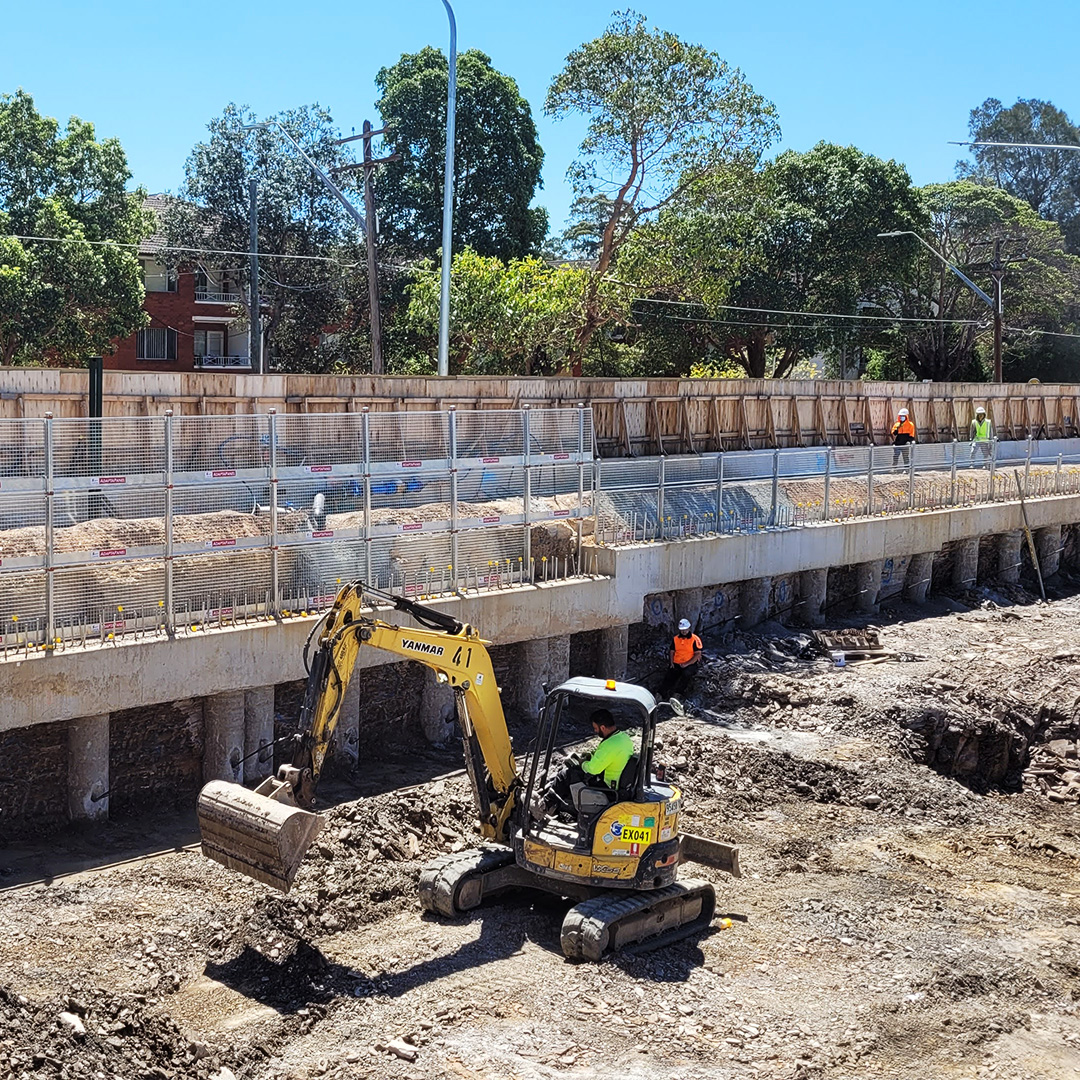
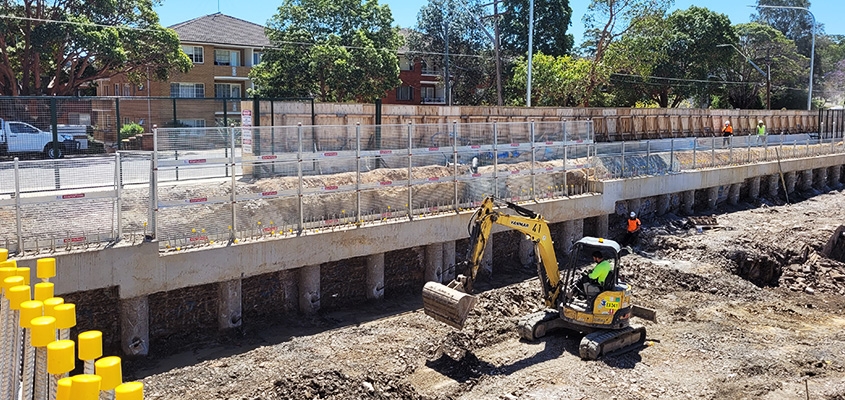
Deep excavation works on site can be an extremely dangerous period for workers, with the risk of injury or death from falls at construction sites, so beam capping edge protection is there to prevent falls from height and debris falling.
Recently, a client required edge protection along a large working face of a basement deep excavation area. Capping beams are the concrete structure that link piles together in deep foundations and help stabilise piles during excavation, while allowing movement from the ground. As the terrain differed in height, the capping beam also had variances throughout the basement work area. Installing 1 metre high edge protection panels would not provide adequate protection at exposed edges, so suitable temporary protection was essential for this structure.
SafeSmart Access’ solution was to provide AdaptaPanel, the temporary works edge protection system that can be easily modified in height. Throughout the working face of the excavation, 1 metre through to 3 metres in height, AdaptaPanels were installed horizontally and vertically. Thus, a consistent barrier between site personnel and deep excavations was maintained. Toe boards can also be used where needed to stop materials or debris falling from the edge.
Compliance, Selection, and Installation
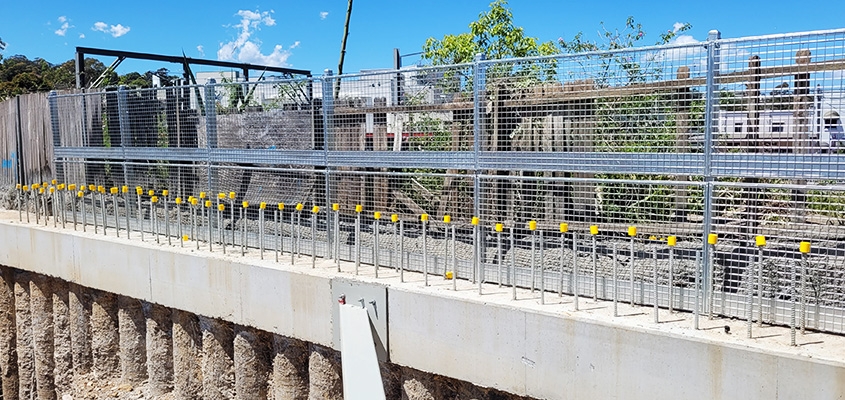
The AdaptaPanel system can be easily bolted to the support surface for fast and simple installation. Multiple post options are available, with 1m, 1.5m, 2m, and 3m height variations that vertically slot securely into each other. 65x65mm posts are standard to the AdaptaPanel system and compliant with AS4994.1.
One of the client’s requirements was that any solution had to move as fast as they do on site, which meant efficiency was key for their selection.
Now, with complete capping beam edge protection, the site crew was impressed by the system’s simplicity of installation, security, and quality. The complete temporary edge protection system was an easy choice for the client to make to prevent worker injuries on site. Meeting site safety requirements, they stated they would definitely utilise the technology in future applications without impeding the construction program.
At SafeSmart Access, we believe that height safety and easy-to-use components do not need to be mutually exclusive. Our combined experience & technical expertise for height safety in the construction industry allows us to empower our clients to reach new heights.
Reach out to us to learn more about how we can help you to overcome your access challenges with unqiue safety solutions that always protect workers..
Temporary Edge Protection Systems that Matter
As of 2026, AdaptaPanel is widely used in a range of construction projects, including high-rise building construction, rail corridor construction, and general excavations. The system has evolved over a long time in coordination with the market’s demands for temporary project hazards on site.
There are now different types of panels and posts ranging from 1m to 4m in height, the WorkThru panel series, and the Trade Series panel. Additional compatible equipment for the range has been developed, such as harness point plates for anchoring and landing gates for crane bins in high-rise construction.
While other market offerings for fall protection exist, there is nothing like AdaptaPanel in terms of flexibility in configuration and installation that the edge protection system offers. We know this because we are constantly innovating solutions for new challenges that our clients face, market test those additions, and launch them to the broad market.
The modular system allows for quick adjustments through the various components for panels and posts, including the Trade Series and WorkThru panels.
Aside from the configuration ease the system provides for engineers, an easy installation experience is just as important for crews on the ground. Depending on the height and load ratings (consult our documentation or technical team), the installation method can be as simple as two screw anchors and two latches per panel, making erection of the edge protection very fast.
For capping beam edge protection, tier 1 contractors return to the system time and time again as their site grows and the scope changes. Plus, it complies with two Australian Standards, whereas most other systems on the market typically comply with only one. AS 4994 is commonly that Australian Standard.
AS/NZS 4994.1
AdaptaPanel complies with AS 4994.1. The standard system uses 65 x 65mm posts, mesh panels and documented fixing arrangements to form a physical barrier around exposed edges.
SafeSmart’s AdaptaPanel has completed design testing of the standard post system and found it compliant with AS/NZS 4994.1. This standard sets the general requirements for the design, manufacture and testing of temporary edge protection equipment.
AS/NZS 4994.1 is not limited to roof edge protection. The wider standard series covers temporary systems used around roof edges, excavations, floor edges and exposed structures. Roof surface-edge installation is addressed under AS/NZS 4994.2. Installation at edges other than roofs is addressed under AS/NZS 4994.3, which is generally more relevant to capping beams and deep excavations.
Compliance applies to the complete installed system, not an individual panel or post. The correct panels, posts, spacing, anchors and supporting structure must be used in accordance with SafeSmart’s technical documentation. Increased heights, stacked posts or custom fixing arrangements may require site-specific engineering.
It’s always important to consult the supporting documentation and the manufacturer for guidance on installation requirements to ensure compliance with the relevant standard.
AS 1657
AdaptaPanel top-mount and face-mount systems also comply with the relevant guardrail requirements of AS 1657:2018. Guardrails are required at any edge where there is a risk of falling from 2 metres high.
AS 1657 covers fixed platforms, walkways, stairways, ladders and associated guardrails. It is often applied to roof access, plant maintenance areas and permanent access routes. Its guardrail requirements may also be relevant where AdaptaPanel interfaces with a fixed platform, walkway, landing or stair.
The two standards perform different roles. AS/NZS 4994.1 addresses temporary edge protection equipment. AS 1657 addresses fixed access systems and guardrails. A project may require both standards where temporary protection is installed beside permanent access infrastructure.
For capping beam applications, the fixing method must suit the supporting concrete and the required post height. Standard top-mount and face-mount details are available. Counterweight systems, shallow-embedment posts and custom configurations must be used with the applicable temporary works design.
Before installation, confirm the edge condition, barrier height, fixing arrangement and supporting structure against the current SafeSmart documentation.
Again, It’s always important to consult the supporting documentation and the manufacturer for guidance on installation requirements to ensure compliance with the relevant standard.
Choosing Beam Capping Edge Protection Systems
Capping beams rarely present a straight, consistent working edge. Changes in beam height, excavation depth, corners and surrounding structures can make a standard 1m guardrail difficult to install across the full work area. And edge protection is often required to be installed before concrete pouring begins, presenting another hurdle for contractors. But there are simple steps to follow for choosing the right Beam Capping Edge Protection solution.
Start by confirming the required barrier height. The system should have documented load and deflection performance at the actual top-rail height being used. A guardrail tested at 1m should not be extended to 2m or 3m without supporting engineering information.
Top-to-bottom protection from the toe board to the handrail is needed to ensure there are zero gaps where tools or other objects could fall.
The fixing method must suit the capping beam and supporting concrete. Top-mount posts may suit clear horizontal surfaces. Face-mount posts can keep fixings and baseplates away from the working surface. Anchor type, embedment depth, edge distance and concrete capacity must follow the approved installation details.
When selecting a system, review:
- Required protection height across the full working face.
- Can accommodate changes in beam level, direction and surface condition.
- Tested loads and maximum deflection at the proposed top-rail height.
- Top-mount, face-mount or engineered fixing requirements.
- Mesh infill and toe-board requirements for falling-object protection.
- Access gates, work-through areas and interfaces with other site equipment.
- Installation, relocation and inspection requirements.
- Temporary works drawings or design certification required for the configuration.
AdaptaPanel is available in post heights from 1m to 4m, with top-mount and face-mount options. Posts and panels can be configured around stepped capping beams, deep excavations, shafts and changing work areas. Mechanical fasteners like screw anchors can be used as post fixings – check with site engineers on avoiding compromising the capping beam. Custom infill panels can also be used where the beam changes direction or profile.
Standard installation details should be used wherever site conditions allow. Counterweight systems, shallow-embedment posts, stacked arrangements and custom components must be supported by the applicable temporary works design.
The selected system should provide continuous protection without creating gaps as the beam height changes. Confirm the proposed layout and fixing method before installation begins.
Always check with local regulations and a design team for compliance.
Investing in AdaptaPanel is a long term commitment that pays dividends the day it’s installed. It’s the difference between scaffolding and other solutions on the market. Talk to us about configuring AdaptaPanel on your site.

